01
Define the problem
A request lands already solved. Work backwards until you find the problem underneath it, and learn to recognize the traps that look like one.
A hands-on guide to thriving in corporate product management.
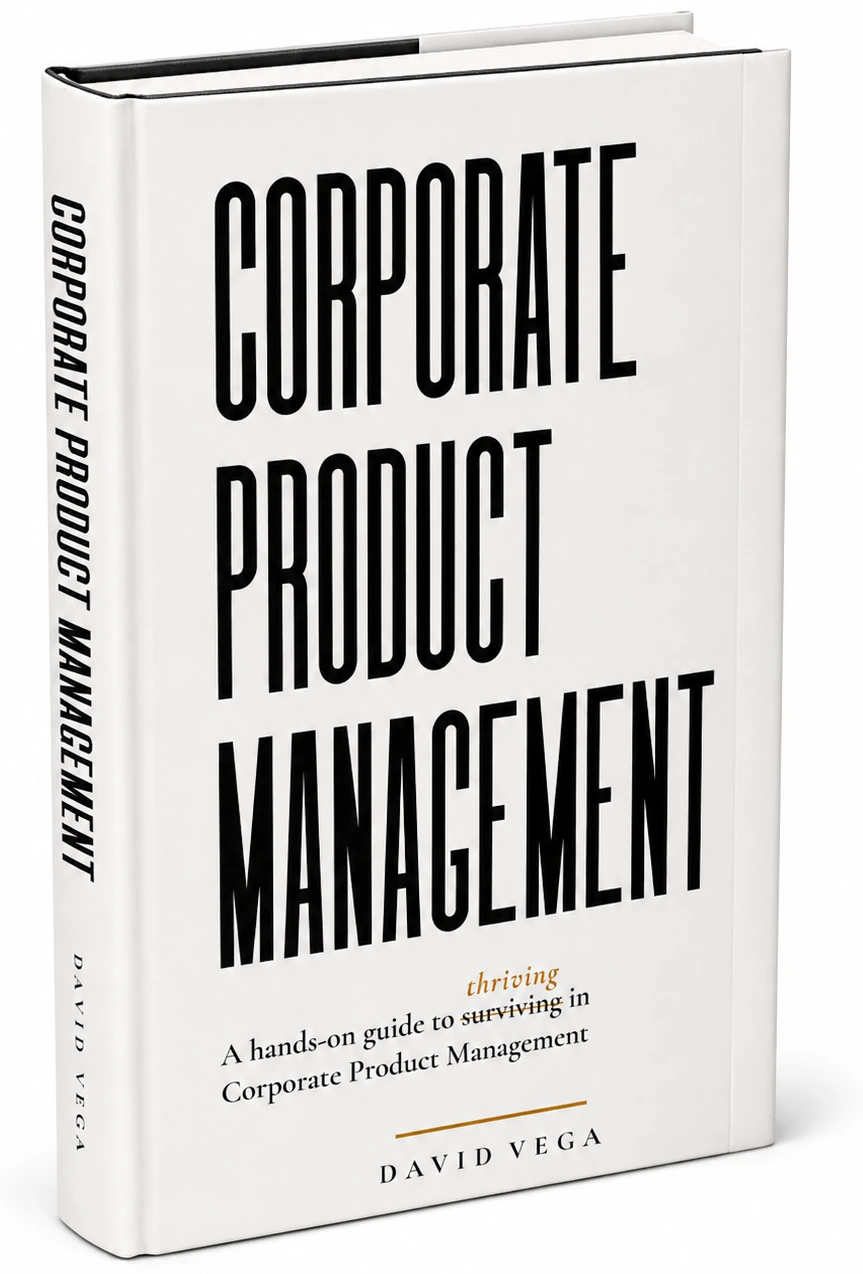
Corporate product management is the art of solving real problems that arrive disguised as solutions.
Inside large organizations, product management rarely starts with a clean problem statement. It starts with asks, opinions, urgency, politics, inherited decisions, and solutions already in motion.
The Head of Operations needs something fixed.
The VP of Sales needs a new capability.
A senior leader wants a dashboard.
The work is not just building products. It is creating clarity when facing ambiguity.
Finding the problem behind the request. Aligning people, teams, and leaders who see the world differently. And turning it all into products that create measurable value.
The framework
Each step hands off to the next, and the last one loops back to the first. Knowing which one you are standing in matters more than reading them in order.
01
A request lands already solved. Work backwards until you find the problem underneath it, and learn to recognize the traps that look like one.
02
Decide whether this problem deserves finite time, budget, and attention, in a product-led org, a business-driven one, or one with no clear goals at all.
03
Who is this for, what do they go through today, where does it hurt, and what would have to be true for that to change.
04
Test whether you are actually right before anyone writes code. The happy path is a liar. Watch the workaround, not just the workflow.
05
Size the first milestone, put it under pressure, and make the ask. Who you ask matters as much as what you ask for.
06
Turn a funded idea into something buildable. Requirements, stories, success criteria, and an honest answer to what your role is during delivery.
07
Something shipped. Now prove it created value, using a metric that survives contact with the people who will question it.
08
The cycle is done. Turn what you learned into the next problem worth solving, and start again with better instincts.
You will not become a great product manager by reading a book. You will become one by doing the work, getting it wrong, and getting a little better each cycle.
Step 1 is the one most product managers skip. The book spends a chapter on it, because every trap below has a chapter of consequences behind it.
“We lack a dashboard.”
Naming a missing thing is not naming a problem. It smuggles the solution in as the diagnosis.
“This came from the top.”
The highest-paid person in the room has already decided, so nobody in the room asks what the problem was.
“Just build the integration.”
The request arrives pre-solved. The reasoning that produced it never gets said out loud, so it never gets tested.
“It has to be this quarter.”
A date replaces a reason. The deadline may well be real, and still nobody has said what happens if you hit it.
“It is on the roadmap.”
Something became a problem because it was funded, rather than getting funded because it was a problem.
“It moves our number.”
One team's metric improves and nothing about the business does. Everyone celebrates, and the number that mattered sits exactly where it was.
What you will find inside are concepts, frameworks, and tips that, over time, will become tools in your belt. Some you will pick up and use the next day. Others will sit quietly until the right moment, and then you will be glad they are there.
When a meeting goes sideways, when a roadmap stops making sense, when a stakeholder shows up with a “must-have” that does not feel right, come back to it. I will not give you the answers, but it will help you ground yourself in the right questions.
I'm not trying to teach you what to think, I want to give you how to think next time you feel out of your depth, so you have somewhere to stand. A framework to follow when nothing else makes sense.
From How to Use This Book, page 1.
Inside the book
PM 101 is the ground the framework stands on. PM 102 is the framework itself. The questions at the back are the ones people ask once the framework meets a real week.
PM 101: Product Foundations
PM 102: Corporate Product
Questions at the back
If there are more vice presidents in your organization than there are countries in the world, this book is for you.
From the opening pages
The framework is the easy part. Most of the book is about what happens when reality pushes back, and there is a section for each of these.
What if leadership just wants you to ship?
What if the problem is buy-in or politics, not the idea?
What if engineering doesn't buy in?
What if enterprise reality gets in the way?
What if I don't know how to calculate ROI?
What if the feedback is all over the place?
About the author
David Vega has spent fourteen years inside Fortune 100 companies, where work almost never arrives as a problem. It arrives as a request, a deadline, or a solution somebody has already promised to somebody else. His job has been to find the problem underneath it, decide whether it is worth finite money and attention, and get an organization that did not ask for it to fund the answer anyway.
He has rarely had authority over the people he needed most, which is the condition this book is written for. Every framework in it was written down after the meeting, not before it.
Anyone curious about product management, anyone already doing the work, and anyone trying to better understand what corporate product managers do. If your day is mostly stakeholders, constraints, and requests that arrive already solved, this was written for you.
Read it cover to cover once, then keep it on the desk and use it as a guide. The eight steps are a loop, so you can also open it at whichever step you are currently stuck in.
Because the constraints are the subject. Startup and scale-up product management get most of the writing, and neither prepares you for competing priorities, existing systems, and stakeholders with formal authority you do not have.
PM 101 covers all three flavors of the role, including startup and scale-up, and the shared vocabulary applies anywhere. The framework in PM 102 is written for large organizations, and it travels well to any team that has to earn buy-in before it can build.
Yes, and the book says so directly. Upload it to the provider you prefer and use it as context when you are working through a real problem. The framework is meant to be reached for on the morning you are stuck.
The text is identical in all three. The hardcover has a printed dust jacket and a binding meant to survive years on a desk. The paperback is the same book in a lighter, cheaper binding. The Kindle edition is searchable and travels.
Get the book
Hardcover and paperback for the desk you come back to. Kindle if you would rather have it on the train.
All three editions, shipped in most regions.
Print editions, online and to order in store.
Hardcover ISBN 979-8-9963775-1-0 Paperback ISBN 979-8-9963775-4-1 First edition 2026 As an Amazon Associate I earn from qualifying purchases.
Somewhere in your inbox there is a request that is not a problem yet. This is the book that helps you tell the difference.